Sunday, 29 December 2013

Top searches for 2013

The top searches of the year from Yahoo, as reported by Anchorman Ron Burgundy. Well worth a watch!


You probably might have guessed the first one Miley Cyrus, the only male to make the list was none other than Justin Bieber. Click here for the full list.


Youtube also weighed in with their most popular videos for 2013. To celebrate the end of the year Google got the top 60 creators on Youtube to summarise the top videos for your enjoyment.


1. Ylvis - "The Fox (What Does the Fox Say?)" by tvnorge
2. "Harlem Shake (original army edition)" by kennethaakonsen
3. "How Animals Eat Their Food" | MisterEpicMann by MisterEpicMann
4. "Miley Cyrus - Wrecking Ball (Chatroulette Version)" by SteveKardynal
5. "baby&me / the new evian film" by EvianBabies
6. Volvo Trucks - "The Epic Split feat. Van Damme" by VolvoTrucks
7. "YOLO (feat. Adam Levine & Kendrick Lamar)" by thelonelyisland
8. "Telekinetic Coffee Shop Surprise" by CarrieNYC
9. "THE NFL : A Bad Lip Reading" by BadLipReading
10. "Mozart vs Skrillex. Epic Rap Battles of History Season 2" by ERB


If you are lucky enough to find yourself travelling internationally over the holidays keep in mind the top location Facebook check ins around the world. They might give you a few ideas when you're there, of course in Australia it had to be the MCG!

Argentina: Puerto Madero, Buenos Aires 

Australia: Melbourne Cricket Ground (MCG), East Melbourne, Victoria 
Brazil: Parque Ibirapuera, São Paulo
Canada: Rogers Arena, Vancouver, British Columbia 
Egypt: Sharm el-Sheikh, South Sinai Governorate, Egypt
France: Disneyland Paris, Marne La Vallée
Germany: Reeperbahn, Hamburg
Hong Kong: 香港迪士尼樂園 | Hong Kong Disneyland
Iceland: Blue Lagoon, Reykjavík, Iceland 
India: Harmandir Sahib (The Golden Temple)
Italy: Piazza San Marco, Venice
Japan: 東京ディズニーランド (Tokyo Disneyland), Tokyo
Mexico: Auditorio Nacional, Mexico City 
Nigeria: Ikeja City Mall, Ikeja, Lagos, Nigeria
Poland: Temat Rzeka, Warsaw 
Russia: Центральный парк культуры и отдыха им. Горького | Gorky Park of Culture and Leisure 
Singapore: Marina Bay Sands
South Africa: Victoria & Alfred Waterfront 
South Korea: Myungdong Street, Seoul 
Spain: Las Ramblas, Barcelona, Catalonia 
Sweden: Friends Arena, Solna
Taiwan: 花園夜市Tainan Flower Night Market, Tainan City
Turkey: Taksim Square, Istanbul
United Kingdom: The 02, London
United States: Disneyland, Anaheim, California


All the best for the New Year.

Jason


Disclosure: Decisive has a long position in Yahoo (YHOO) and Facebook (FB) stock 

The material in this article is for informational purposes only and in no way constitutes a solicitation of business or investment advice. The material has been prepared without regard to any client's or other person's investment objectives. Before making an investment decision you should consider the assistance of a financial adviser and whether any investment or service is appropriate in light of your particular investment needs.

Sunday, 15 December 2013

Santa shareholder benefits

The Wall Street Journal recently published a good article on stocks with shareholder perks. It identified Ford shareholders as the biggest winners with the largest savings potential. Shareholders are offered near employee prices provided they own a minimum of 100 shares (last share price $16.50) for at least the past 6 months. Shareholders only pay 4% above the employee price saving shareholders hundreds or even thousands of dollars on the purchase price. Unfortunately this trend of extra shareholder benefits has decreased over time. The WSJ article talks about how Disney used to give shareholder discounts to its theme parks and how Starbucks no longer slips gift cards into annual meeting reports.

But what about here in Australia? The trend is similar to the US. Coles famously closed down their shareholder discount cards a number of years ago which outraged retail investors especially since it offered discounts of up to 10% on weekly shopping expenses. It is now seen as normal to concentrate on shareholder returns rather than benefits. Thankfully there are some companies out there that reward shareholders with other benefits, though they tend to only be in the entertainment and retailing industries.

Even a bank offers a shareholder discount
A number of banks used to offer discounts on home loans but now it is only NAB a shareholder with over 500 shares will see their annual credit card fees waived. Who said all banks were greedy! Unfortunately NAB have cancelled their shareholder package home loan discontinued in August 2012.

Funnily enough AMP is not a bank but it does offer home loan discounts. As a shareholder you can receive a discount of up to 0.85% on loans from $100,000-$499,000 and up to 1% off variable loans above $500,000.

Blackmores offers shareholders an order form with 30% off recommended retail prices though it needs to be for personal use only.

For the travellers out there Amalgamated holdings provides some of the best benefits. They even provide a shareholders benefits pamphlet (see below). Holders of 500 or more shares of the company get 10% off Rydges and QT hotels. Shareholders can also pay $10.50 for tickets at Greater Union and Birch Carroll and Coyle cinemas and get 10% off sky lift tickets at Thredbo.


Ardent Leisure offers similar value to shareholders with at least 2,000 shares. An investor benefits card is mailed out to newly eligible investors within a few weeks of becoming an investor. Investors gets discounts to Dreamworld and can save up to 50% off at SkyPoint at the top of Q1 on the Gold Coast.

Lastly for the gamblers and travelers out there Echo Entertainment offers shareholders 10% off rooms at The Star in Sydney, Jupiters Casino on the Gold Coast, Treasury casino in Brisbane and Jupiters Townsville. The shareholder benefits card also gives holders 10% off food and drinks at the majority of restaurants.

If you can't find that last minute gift maybe one of these vouchers can help you out, Merry Christmas!

Jason


The material in this article is for informational purposes only and in no way constitutes a solicitation of business or investment advice. The material has been prepared without regard to any client's or other person's investment objectives. Before making an investment decision you should consider the assistance of a financial adviser and whether any investment or service is appropriate in light of your particular investment needs.

Sunday, 8 December 2013

Solarcity pay for power not panels

Solarcity (SCTY) provides customers with a cleaner and more affordable alternative to their utility bill through the use of solar power. What makes SCTY different is that customers have the option of buying their own solar panel system upfront or they can lease panels like in a normal electricity agreement. The majority 52% of sales are sold as solar as a service similar to paying a utility, consumers pay for power and not panels. SCTY enters into long term 20 year contracts with consumers and finances the panel for the consumer. SCTY makes money by pocketing the long term value of the contracts minus the upfront cost of the panel. Customers benefit by saving up to 15% of their electricity bill while being more environmentally friendly and avoiding the near $20,000 upfront cost of solar panels.


I see the light
The solar power system will be interconnected to the local utility grid so that you won’t experience any power interruptions. Most of the parts such as solar panels, carry manufacturer's warranties of 25 years; other parts, such as inverters, carry 10-year warranties. In addition, SolarCity offers 20 year warranties including monitoring and repair service. If you generate more solar power than you require you get a credit for your bill. The interesting thing about solar is that it generates it power when utility rates are at their highest.


As can be seen in the slide above rooftop solar provides 0.1% of the electricity today. The Department of Energy has estimated that it could contribute 3.5% of US electricity by 2030. SCTY is dominant in the space with around 26% share of installations and an installed base of 0.5 GW with 75,000 customers. It is a long range target out to 2018 but they expect to have 1 million customers and 6GW of capacity by that time. SCTY believe their addressable market to be 41 million homes.

Risks
Rising interest rates play a massive part in any valuation. Due to the fact that the panels are funded upfront while SCTY receives payments over a 20 year annuity stream.  Another risk is tax credits which are scheduled to reduce from 30% to 10% by 2017. Offsetting some of this risk is the likelihood that the price of panels should reduce over time.

Disrupting utilites
The majority of competitors are private the industry is fragmented with most of the work done by local installers like plumbers and landscaping businesses. At the end of the day solar is a scale and financing business, being listed allows SCTY to have a financing advantage over competitors. Utilities themselves are potential competitors if they enter the roof top market. The great part about SCTY's model is that it bypasses the distribution system of utility providers giving users a choice of provider. SCTY can create energy at the place it is needed instead of a centralized monopoly (utility) that is miles away.

Elon Musk not just electric cars
The CEO and CTO are the cousins of Elon Musk who is chairman and a significant shareholder at 25% with total insider ownership at 33%. Elon Musk if you don't know is one of the great entrepreneurs, a co-founder of Paypal, Tesla and Space X a rocket company that produced the first privately developed liquid fueled rocket to reach orbit. As with everything Elon does SCTY is a company that has the opportunity to disrupt a large market.

While difficult to value SCTY has the potential to be the most compelling energy company of the future.

Jason


Disclosure: Decisive has no long position in Solarcity (SCTY) stock 

The material in this article is for informational purposes only and in no way constitutes a solicitation of business or investment advice. The material has been prepared without regard to any client's or other person's investment objectives. Before making an investment decision you should consider the assistance of a financial adviser and whether any investment or service is appropriate in light of your particular investment needs.

Sunday, 1 December 2013

Activision Blizzard the Disney of gaming

Activision Blizzard (ATVI) is the world’s largest and most profitable independent gaming company. ATVI develops and publishes some of the most successful entertainment franchises on any medium, including Call of Duty, Skylanders, World of Warcraft, StarCraft® and Diablo.

Gaming is a bit like the movie business the hits need to keep coming but some companies are just able to keep on executing, with their track record ATVI could be described as the Disney of the gaming industry. ATVI's management track record is the best in the business they have created many $1bn+ franchises from scratch. Other competitors like Electronics Arts license brands like Star Wars and sports but ATVI actually creates and therefore owns the content which gives rise to other opportunities like licensing. Games can now gross and cost a similar amount to movies but provide even more monetisation opportunities for die hard fans like extra micro transactions (in game purchases) and on going subscription fees (World of Warcraft a major driver of profit was first released in 2004).

A new console cycle
The new consoles the PS4 and Xbox One are 10x more powerful than the previous cycle. They are also more digitally friendly with the introduction of new payment systems with similar capability to the PC like monthly billing. These devices are also able to download games incrementally so there is no need to download the entire game before you can play. As can be seen below digital allows ATVI to increase overall margins due to decreased marketing and distribution costs. Around 45% of ATVI's revenues are digital that is subscriptions, digitally distributed products and downloads.


The consoles are also more social in that they allow sharing of experiences and incorporate the second screen of mobile in many games. Past console transitions have successfully expanded the market and business opportunity for software providers but in the short term drive uncertainty as gamers hold off on purchases ahead of new releases while sales of the new console take time to ramp up.

Its all about the franchises
Blizzard is well known for its PC based titles of Warcraft inlcuding the largest online multiplayer game World of Warcraft with 7.5 million subscribers and Starcraft and Diablo. Activision is better known for its first person shooters such as Call of Duty/Cabela's hunting and the introduction 3 years ago of interactive toy figure gaming for kids Skylanders. ATVI's four largest franchises in 2012—Call of Duty, Diablo, Skylanders and World of Warcraft—accounted for approximately 83% of net revenues. Call of Duty is facing competition from Battlefield 4 and Skylanders from Disney Infinity. High hopes are placed on a new first shooter franchisee Destiny to be released next year.


China finally cracked?
China has been a struggle for developers to crack due to regulation and the difficulty of distributing games. Like most industries in China the game market is showing tremendous growth with more online gamers than the US and Japan combined. Tencent is the key to distribution in China. Tencent is a US$100 billion company with over 800 million users. Tecent is a social messaging service which is monestised mostly through free to play games that have in game purchases. Tencent and ATVI have teamed up to distribute a free to play version of Call of Duty specifically for China. This has the potential to become a billion dollar business given Tencent's current first person shooter CrossFire has arguably poorer graphics yet brings in $1 billion per year. The game is slated for release next year.

Vivendi has traditionally controlled ATVI but due to high debt levels has sold back some of its stake back to ATVI and to Tencent its China partner. Its interesting that ATVI could buy back 429 million shares for $5.8 billion just ahead of a new console transition. The newly independent ATVI will allow management to focus more on their operations and increase the company's strategic flexibility.

Jason


Disclosure: Decisive has no long position in Activision Blizzard (ATVI) stock 

The material in this article is for informational purposes only and in no way constitutes a solicitation of business or investment advice. The material has been prepared without regard to any client's or other person's investment objectives. Before making an investment decision you should consider the assistance of a financial adviser and whether any investment or service is appropriate in light of your particular investment needs.


Sunday, 24 November 2013

Linkedin the social network

Linkedin (LNKD) was one of the first global social networks founded one year ahead of Facebook in 2003 and three years ahead of Twitter. Globally LNKD has 259 million members and signs up more than two new members every second, while its not the largest social network LNKD has produced the best returns for shareholders. It has also flown under the radar news wise compared to Twitter and Facebook with no movie or books produced about the founding of the company or any controversial privacy and political issues.

Its not just advertising
As a company LNKD is quite different from its social media peers in that advertising only drives 23% of revenues. The majority of revenue comes from its talent solution products which are subscription fees charged to recruiters to access their database of professionals. The other major revenue stream is LNKD's premium subscriptions which unlock greater functionality to users to better see connections and the ability to contact users (important for marketers).


Its all about the passives
LNKD estimates that around 10-15% of the workforce are looking for work at a point in time. Obviously if you were to focus on just that pool companies would be missing out on a lot of potential candidates, historically this was where recruiters added value with their contacts of passive candidates. However LNKD's better mousetrap has enabled companies to search and target the 85% pool directly who are not actively looking for a job.

According to the CFO LNKD has three competitors for its products, personal referrals, internal hires and LNKD's own basic products for which users do not have to pay. Its a big statement LNKD is effectively saying that there is no comparable product out there. In his words "what we do is so unique right now, particularly since the biggest piece of the business is related to passive recruiting, the ability to find people who are perhaps in jobs and to be able to do it vis-à-vis very powerful search and the ability to see how you're connected to that person, has a very high ROI. That, I think, only we can do."

While there are many recruiters using the service there are still over 250,000 companies around the world with over 100 employees that could probably justify using the talent solution recruiting tools. This is a big market compared to the 22,000 users in the September quarter.

More marketers than recruiters
Large sales team are another market for LNKD database. LNKD's network of connections enables sales teams to better target and close sales. For example if before making a call a salesperson knew a colleague went to school with a lead then he could provide an introduction instead of making a cold call improving the chances of success. This new product called Sales Navigator costs $50 a month. LNKD is moving slowly with the product as they need to balance the privacy of users. LNKD has put in a number of constraints like amount of emails sent per month so that the service does not become annoying to users. LNKD believes that better targeting will reduce the amount of spam around the world and actually be useful to users.

Not banned in China
What is most interesting about LNKD is that it is not banned in China like the other social networks like Facebook and Twitter. LNKD has no corporate presence in China and no Mandarin language support for its services yet it has still signed up 3 million users in English. It seems even the Chinese government will tolerate the risk of a social network if the focus is to recruit and find jobs for candidates. This is obviously a big opportunity for LNKD as more than 6 million university students graduate in China each year.

What about Australia? 
LNKD has announced that as of October 2013 its membership base in Australia has surpassed 5 million up from 540,000 five years ago.

According to the press release the top 5 companies by employee members in Australia are basically the top 4 banks. 

Top companies by members in Australia

1. Telstra
2. National Australia Bank
3. Commonwealth Bank
4. ANZ
5. Westpac

Out of the top 5 industries represented no. 1 is IT but surprisingly construction is no.2

Top industries
1.       Information Technology and Services
2.       Construction
3.       Financial Services
4.       Education Management
5.       Hospital & Health Care
The majority of titles are management related

Top Titles
1.       Owner
2.       Director
3.       Manager
4.       Managing director
5.       Teacher


With its three revenue streams of marketing, advertising, recruiting and the potential of China, LNKD provides its customers with more value than the other social networks. LNKD is much more than a Facebook/Myspace with Ties!


Jason


Disclosure: Decisive has no long position in Linkedin (LNKD) stock 

The material in this article is for informational purposes only and in no way constitutes a solicitation of business or investment advice. The material has been prepared without regard to any client's or other person's investment objectives. Before making an investment decision you should consider the assistance of a financial adviser and whether any investment or service is appropriate in light of your particular investment needs.

Sunday, 17 November 2013

Iconix the second largest licensing company in the world (after Disney)

Very few public companies derive 90% of revenues from licensing a portfolio of brands. Iconix Brand Group (ICON) is unique in that ICON wholly or partially owns 33 consumer brands. In the latest top 150 global licensors awards ICON's brands reported sales of $13 billion 2nd behind Disney and just ahead of PVH corp which owns Tommy Hilfiger and Calvin Klein in number 3.


Importantly ICON does not have fashion risk as it receives guaranteed royalties. ICON does not take inventory risk and receives minimum royalties from its licensees which average around 3% of sales. Licensees must also make minimum payments for marketing the brands. As of June 2013 ICON had the right to receive over $800 million in minimum royalty revenue from their current licensees this compares to revenue of $430 million this financial year. Impressively ICON does this all with little infrastructure with only 148 employees, in 2012 each employee generated $2.4 million in sales.

ICON already does business with every retailer in America, to grow further ICON must tap into other areas like retailers such as Home Depot and Petsmart. The acquisition of Peanuts, Snoopy and Dilbert (a hero to cynical office workers) helps move the company from just fashion to media, theme parks and financial institutions.


Peanuts the movie!
ICON formed a partnership with the Schulz family and bought into 80% of the business with the Schulz's owning the rest. No new Peanut comics have been drawn for a decade and as a brand Peanuts and Snoopy have stalled. The brand was acquired in 2010 and sales have flattened out at $80 million for the past two years ICON hopes to reboot the franchise with an upcoming movie in 2015. If all goes to plan ICON believes that sales of Peanuts products including box office could double to $160 million.

The movie in conjunction with Twentieth Century Fox is slated for release November 2015. While the contract details have not been disclosed ICON has hinted that it is similar to goods licenses in that they receive a royalty piece from every movie ticket sold. ICON is hopeful that the movie will create new licensing opportunities and box office sales that will drive new revenue streams. ICON is not putting any money down which is fortunate given the last Peanuts movie in 1980 earned just $2 million.

Snoopy the credit card?
Metlife has used Snoopy as their company ambassador since 1985. In 2006 Metlife acquired exclusive international rights to use Snoopy in financial services including credit and debit cards. These contracts are up for renewal in 2014. According to Forbes magazine the licensing deal brings in $12 million annually.

Growth getting harder to come by?
International is a key driver for growth at just 33% of business it can still grow. Whereas in America ICON's brands already take up a lot of shelf space with around 14% of Walmart soft goods, 15% of Target and 10% of Kmart. Their top 5 customers contribute 36% of revenue. ICON has always been able to renew contracts above $10m in value but due to the sliding scale royalty structure the % earned decreases as the brand grows.

ICON is a unique company given the licensing structure. However ICON is reliant on Peanuts to be a success as they are fully distributed within US fashion retail. Let's hope that Snoopy stays on top and does not end up inside the doghouse!

Jason


Disclosure: Decisive has no long position in Iconix Brand Group (ICON) stock 

The material in this article is for informational purposes only and in no way constitutes a solicitation of business or investment advice. The material has been prepared without regard to any client's or other person's investment objectives. Before making an investment decision you should consider the assistance of a financial adviser and whether any investment or service is appropriate in light of your particular investment needs.

Sunday, 10 November 2013

Its a Sony

Consumers know Sony (SNE) for its electronics business, movies, music and through Playstation its games. In the stockmarket SNE trades mostly as an electronics business yet the majority of profits come from its financial, movies and music divisions.

As everyone knows SNE used to be the dominant electronics company but in the past decade SNE has been left behind by Apple and newer Korean competitors like Samsung. There are signs of change with a new CEO Kaz Hirai, Kaz has set about on an aggressive turnaround with a focus on one Sony with products that incorporate both hardware and software. However after two straight profitable quarters SNE recently announced a second quarter loss dealing a massive setback to SNE's turnaround ambitions. The downgrade was so bad that Moody's warned SNE credit rating could be cut to junk.


Why SNE? Thriller content
SNE owns some of the best music content in the world, it is the second largest global music company and has full or partial rights to the catalogs of Michael Jackson and the Beatles. Michael Jackson and the Beatles alone are a gold mine but SNE also owns Usher, Eminem and even rights to One Direction. The company has over 2 million songs in its catalogue. Part of Kaz's plan is to shed more light on the music and picture segments and finally give investors access to SNE's entertainment management team on meetings and conference calls.

SNE also owns many notable movie franchises including Spider-man, the Karate kid and Men in Black. Their TV catalogue includes I Dream of Jeannie, Bewitched, All in the Family and rights to the Seinfeld library. SNE owns 124 channels in more than 159 countries the majority in Latin America and Asia. SNE monetises their film library content through iPad apps on Crackle an online ad supported viewing service and through Vevo a collaboration with Universal and Google where users can watch the latest in music videos.

Seinfeld no soup for you! Sony owns the rights

SNE is also the creator of the Playstation with the fourth version out next month. This will be SNE's first release of a console in eight years. The pricing is expected to be priced less than Microsofts XBox and include more cloud based services and sharing such as making it possible to view ingame action streamed live to friends.

Why not SNE? Electronics not so thrilling
Kaz's goals are to return the electronics business to profitability. However they are structurally challenged industries with the television business unprofitable for the last number of years. PC, TV and camera sales are all struggling from the move to tablets and smartphones. My original thought was to value these divisions at a zero valuation but some sort of negative value needs to be attributed given the large capital requirements and relatively tough workplace restructuring rules in Japan.

SNE bought out Ericsson's stake in their mobile joint venture after ten years. This made sense as SNE can now integrate its software and all devices and they could finally focus on smartphones! The agreement also gives SNE ownership of some interesting patents whose coverage and worth is hard to determine. Even though smartphone sales are off a small base they are heading in the right direction.


Abenomics
Shinzo Abe the new Japanese prime ministers attempt to revive Japan's economy should help SNE as a depreciating Yen makes SNE goods more competitive overseas. SNE also has a financial services business made up of mainly life and auto insurance SNE will benefit from the rising stockmarket with the Nikkei 225 being one of the best performers in the world.

On the downside the consumer electronics business will keep detracting from the picture, movie and gaming assets. Dan Loeb the activist hedge fund manager is a shareholder and has pushed for a partial listing of its entertainment assets. Personally we would like SNE to keep their best assets and see a spin off of their consumer electronics business as investors (including ourselves) seem to attribute a negative value to the assets.

It seems all technology companies are following Apples path of integrating hardware and software. SNE and Microsoft have always had the ability to do the same but both seem more determined this time around. There is definitely value in SNE it just needs to be unlocked, we will stay tuned!

Jason


Disclosure: Decisive has no long position in Sony (SNE) stock 

The material in this article is for informational purposes only and in no way constitutes a solicitation of business or investment advice. The material has been prepared without regard to any client's or other person's investment objectives. Before making an investment decision you should consider the assistance of a financial adviser and whether any investment or service is appropriate in light of your particular investment needs.

Sunday, 3 November 2013

The Kentucky Derby

Its Melbourne Cup week and as thoughts turn to betting and horse racing we thought its time to take a closer look at Churchill Downs (CHDN). CHDN owns the race course for the most exciting two minutes in sport the Kentucky Derby. The track is 2 kilometers long and is the longest running annual sporting event in the US run over 139 consecutive years. The race is also known as the run for the roses with a blanket of 564 red roses awarded to the winner each year.

The big board
Ever been that fan who spent the day at the races but never saw a horse? CHDN understands so they have installed what they call the Big Board for the 2014 race. In partnership with Panasonic CHDN has installed a 15,224 square foot high definition LED video board, the board will be 171 feet long and the structure 170 foot tall. The board and structure will weight over 1,000,000 pounds and is bigger than 3 NBA basketball courts or 2,200 46 inch flat screen TVs.


Sports not gambling
CHDN makes the majority of its revenue through premium ticket sales the largest contributor at 50% of revenue with the rest split between sponsorships, wagering and TV licensing. Unfortunately the rest of racing is not profitable CHDN typically makes a profit in the second quarter when the Derby is run the rest of the year is relatively quiet and unprofitable.

The TV rights (with NBC) and sponsorship (Yum Brands) are up for grabs following the 2015 race and given the increased focus on live sports for advertising we believe CHDN is well positioned for improved terms. Both deals were renewed in 2011 and the Derby's popularity has increased since with 16.2m viewers this year up from 9% in 2012 and up 12% in 2011. The race is unique as it is the only annual sporting event that draws more female viewers than male at 52%. CHDN believes that the Derby is worth a lot more if it was valued as a sports rather than betting asset.


Regional casinos but some online
The problem is CHDN has been buying regional casinos with racing now only contributing 34% of revenue compared to 69% in 2009. Because of these diversification efforts CHDN has been valued more as a regional gaming asset than a unique sporting event. CHDN also has an interesting online wagering business which is 20% of revenue the site TwinSpire.com is a leader in the market with 42% US marketshare. While online growth is slow, the recent quarter showed 7.3% growth this compared favourably to overall industry growth of 1.3%. Wagering was already declining and the financial crisis has added to industry woes with wagers down 20% from the peak in 2008.

CHDN will conduct the 140th running of the Kentucky Derby on the 3rd of May 2014. Giddy up!

Jason


Disclosure: Decisive has no long position in Churchhill Downs (CHDN) stock 

The material in this article is for informational purposes only and in no way constitutes a solicitation of business or investment advice. The material has been prepared without regard to any client's or other person's investment objectives. Before making an investment decision you should consider the assistance of a financial adviser and whether any investment or service is appropriate in light of your particular investment needs.

Sunday, 27 October 2013

Callaway Golf Fore!

Callaway (ELY) is one of the best known golf brands in the world selling its products in more than 70 countries worldwide. However since the passing of its founder in 2001 ELY has struggled as the brand became less focused on drivers and clubs and its core golf users.

The golf industry as a whole has suffered from the financial crisis with industry golf sales down 13% from the 2007 peak. Within this decrease ELY has consistently lost market share as competitors such as TaylorMade (owned by Adidas) and Titleist (owned by Fila) stepped up marketing and innovation. However there are signs of a turn around with ELY's marketshare of 15.1% year to date up 1.1% on last year (See ELY marketshare below). Importantly their latest results are showing signs of profitability with expectations for a 2013 pre tax income.


In the CEO's words "with that said, our turnaround is proceeding at or above our original expectations, particularly given the headwinds we experienced this year from unfavorable changes in foreign currency rates, adverse weather conditions, a very late start to the 2013 golf season, and higher than normal promotional activity in both North America and Europe."

The turnaround
New management, a change in marketing, product execution and a reduction in cost structure have helped. The new CEO brought in last year Oliver Brewer has streamlined their business by selling the Ben Hogan and Top Flite brands. 

He also licensed the apparel operations to third parties so that ELY could focus on its core club and ball business. ELY's cost structure was reduced to $340 million down from last years run rate of $380 million in expenses reducing the number of employees from 1,800 to 1,500 as of December 2012.

ELY beefed up marketing signing endorsement deals with Phil Mickelson, Ernie Ells and Ryo Ishikawa. Though Phil Mickelson was recently spotted using a TaylorMade driver. Apparently Phil has one of the most flexible equipment contracts of any top player and can play with other brands from time to time.

View image on Twitter


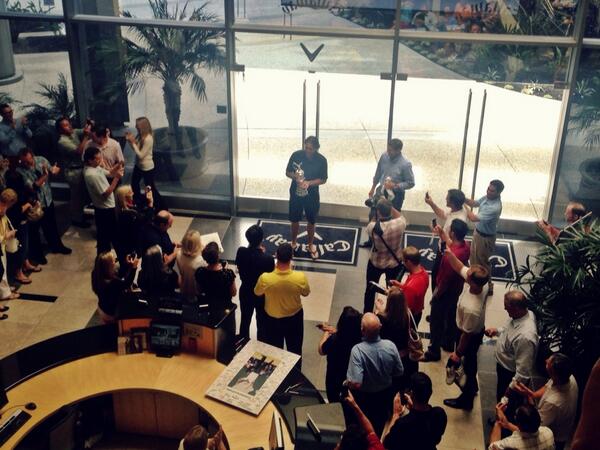
Phil at Callaway HQ thanking the staff for their support after British Open win.

The back nine
Golf becomes an Olympic sport at the 2016 Rio games with the 2020 games awarded to Tokyo. Japan is the largest international market for ELY. There is also the Chinese golfing opportunity, with gold medals now on offer and China's historic dominance in sports involving  mental focus golf in China will surely be a driver of growth.

After years in the rough ELY now looks to be finishing under par.

Jason


Disclosure: Decisive has no long position in Callaway (ELY) stock 

The material in this article is for informational purposes only and in no way constitutes a solicitation of business or investment advice. The material has been prepared without regard to any client's or other person's investment objectives. Before making an investment decision you should consider the assistance of a financial adviser and whether any investment or service is appropriate in light of your particular investment needs.

Sunday, 20 October 2013

A Chinese Gumtree

58.com is China's largest online marketplace. Similar to GumTree here in Australia and Craigslist in the US 58.com enables local merchants and consumers to share information and conduct business.

58.com had approximately 4.3 million active local merchants out of an estimated 53 million small medium businesses in China. 58.com is the leader in online classifieds with 38% market share by revenue and 86 million monthly unique visitors. Its rivals include Ganji and Baixing though 58.com has 2x and 9x more revenue respectively than these competitors (see chart below).


Big partners
58.com introduced Alipay (owned by Alibaba) services earlier in the year. Alipay is similar to Paypal but differs in that is more like an escrow service. So just like Taobao customers 58.com consumers can decide to release payment after having enjoyed a service or bought a second hand item. This was the first time that Alipay had developed a custom solution for a third party and helps overcome the lack of trust in buying online in China. A survey conducted by 58.com shows that 90% of its users trust Alipay and 75% have Alipay accounts.

58.com has also begun to use Baidu (Google of China) new light app feature. So users will be able to search through the app without having to physically download the application on the mobile. Around 40% of 58.com page views were on mobile applications.

Show me the money!
Like most internet companies 58.com earns its revenue through advertising. Though the majority 60% is subscription based. A membership gets merchants an online storefront, preferential listing benefits and a higher quota for daily listings. These contracts typically last from one month to a year. Approximately 273,000 merchants subscribe to the service. Renting, jobs and their yellow pages services are the most popular.


58.com has begun focusing on advertising to drive more growth. Only 18% of 58.com's paying merchant members used online marketing services. 58.com have also rolled out realtime bidding similar to Google adwords this allows merchants to bid real time on certain keywords to improve the chances of their listings being seen and sold.

China has 45 cities with a population greater than 2 million this compares to only 4 cities in the US. Given the low monetisation compared to peers the stock is one to watch. 58.com's IPO will price at the end of the month.

Jason


Disclosure: Decisive has no long position in 58.com (WUBA) stock 

The material in this article is for informational purposes only and in no way constitutes a solicitation of business or investment advice. The material has been prepared without regard to any client's or other person's investment objectives. Before making an investment decision you should consider the assistance of a financial adviser and whether any investment or service is appropriate in light of your particular investment needs.